How to Decode German Wine Labels
On one of our first trips to Germany we learned the truth about Riesling: Not all Riesling is sweet. This was years ago when we were still learning about wine, and up until then thought (wrongly) that Riesling meant sweet wine. But on that trip we learned that German Rieslings run across the spectrum and can range from bone dry to intensely sweet. Then our question became: how do you know from looking at a label what’s dry and what’s sweet?
German Rieslings sometimes include a scale on the back of the label to help you determine the sweetness level, but not always. Even if that scale isn’t written on the label, though, you’ll find clues.
If the German word “Trocken” appears anywhere on the wine label, that tells you it’s a dry wine, but you can also look at the ABV (Alcohol By Volume) percentage to get a good sense of the sweetness.
When wine goes through the fermentation process, sugars are converted to alcohol, so higher alcohol means lower residual sugars and the drier the wine will be. And vice versa, with lower alcohol, more sugars remain, and the wine will be sweeter.
The Riesling grape is known for its high acidity, which often means that even a lower alcohol wine (which generally tells you there’s some sweetness) is balanced by the high acidity, and the Riesling will taste drier on your palate.
Get to Know German Wine
One of the best ways to get to know German wines is to drink them, of course. Purchase several with different sweetness levels and taste them side-by-side to get a better feel for your preferences. An even better way for learning is to visit the German wine regions for first-hand experiences. Different German wine regions have different climates, and some areas produce riper, more concentrated grapes, while other areas are cooler and retain higher acidity.
Even if you tend to prefer drier wines, don’t skip a trusted wine pairing of a semi-sweet or sweet Riesling with spicy foods. Try spicy chicken wings, Szechuan pepper dishes, or Korean kimchi with a sweeter Riesling, and you’ll be surprised how well it pairs.
A Guide to Understanding the German Wine Classification System
Even wine pros have difficulty wrapping their heads around the German system, but it’s less complicated than it looks. Everything rests on how ripe the grapes were at harvest and the wine’s sugar content.
The system is divided into two main categories: Quality Wines and Table Wines. Quality Wines are further divided into Prädikatswein and Qualitätswein bestimmter Anbaugebiete (QbA), each with their own set of classifications.
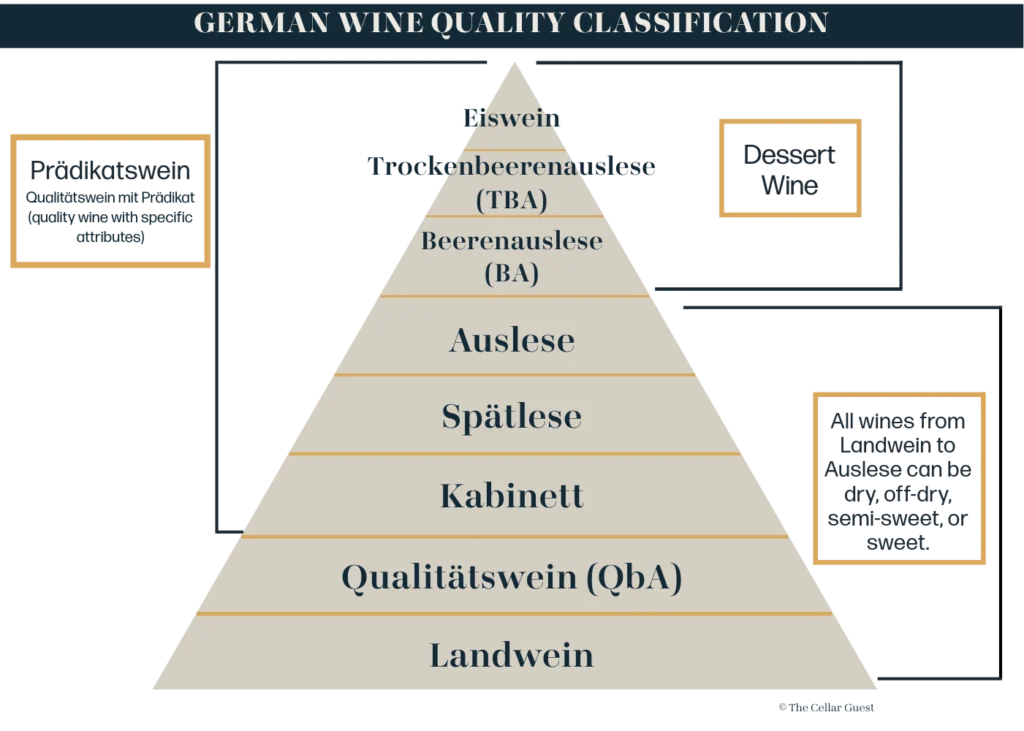
Use our pyramid graphic below to help get a visual of the quality levels, and we’ll start explaining the categories from the bottom to the top.
Landwein
Deutscher Landwein is Germany’s table wine category made from ripe and slightly under-ripe grapes. Primarily consumed in Germany, very little is exported, so you’ll likely only find this category of wine if you visit Germany.
Qualitätswein bestimmter Anbaugebiete (QbA)
Wines in the Qualitätswein category must be produced within one of the 13 wine-growing regions of Germany, and they have to meet certain requirements regarding grape variety, ripeness, and alcohol content.
The grapes are at a fairly low level of ripeness and the wines range from dry to semi-sweet. The style is often indicated on the label, along with the designation Qualitätswein and the region.
Prädikatswein
These are the highest-quality wines in Germany. They are classified according to the ripeness of the grapes at harvest and include the following six categories in ascending order of ripeness: Kabinett, Spätlese, Auslese, Beerenauslese, Trockenbeerenauslese, and Eiswein.
Kabinett
Kabinett wines are made from fully ripened grapes picked at normal harvest time. This term may have originated from the idea that the winemaker felt it was good enough to put in his own cabinet rather than offer it for sale.
Spätlese
Spätlese (translates to “late harvest”) wines are made from riper grapes picked at a later stage in the harvest. The longer the grapes are on the vine and the later they’re harvested, the more sugar is able to develop in the grape. However, the winemaker may choose to fully ferment the wine dry, in which case you will typically see “Spätlese Trocken” on the label.
Auslese
Auslese (translates to “select harvest”) indicates a wine made from hand-selected, very ripe grapes. Sometimes, these select harvest grapes are infected with noble rot, in which case they’ll certainly be a sweet wine. But, again, they can be vinified dry and produce a full-bodied, high-alcohol wine and aren’t always sweet.
Beerenauslese (BA)
Beerenauslese (BA) (“berry select harvest”) wines are made from individually selected, overripe berries that usually were infected by botrytis cinerea (or noble rot). These are rarities, harvested only when exceptional weather conditions enable the grapes to ripen to this extent. They are notable for their longevity and can age for decades.
Trockenbeerenauslese (TBA)
Trockenbeerenauslese (TBA) (“dry berry select harvest”) wines also have extraordinary longevity. These rare and treasured wines are made from individually selected grapes that are overripe and dried up almost to raisins, usually infected by noble rot and picked very late in the season. BA and TBA cannot be harvested mechanically, and each berry must be picked individually by hand, which means the wines can command impressive prices because of the costs involved in producing the wine.
Eiswein
Eiswein (“ice wine”) is made from grapes as ripe as those used for Beerenauslese that have frozen on the vine. They are harvested only under exact weather conditions and pressed while frozen and produce a highly concentrated and sweet wine. The pressings give only a tiny yield, and coupled with the gamble a winemaker takes hoping the weather cooperates, this wine is a rarity.
These days we keep bottles from across the sweetness spectrum on hand. A dry Kabinett with roasted pork, a Spätlese with anything spicy, and a lusciously sweet Beerenauslese with dessert. Finding the dish that makes each style of Riesling shine is our type of fun.